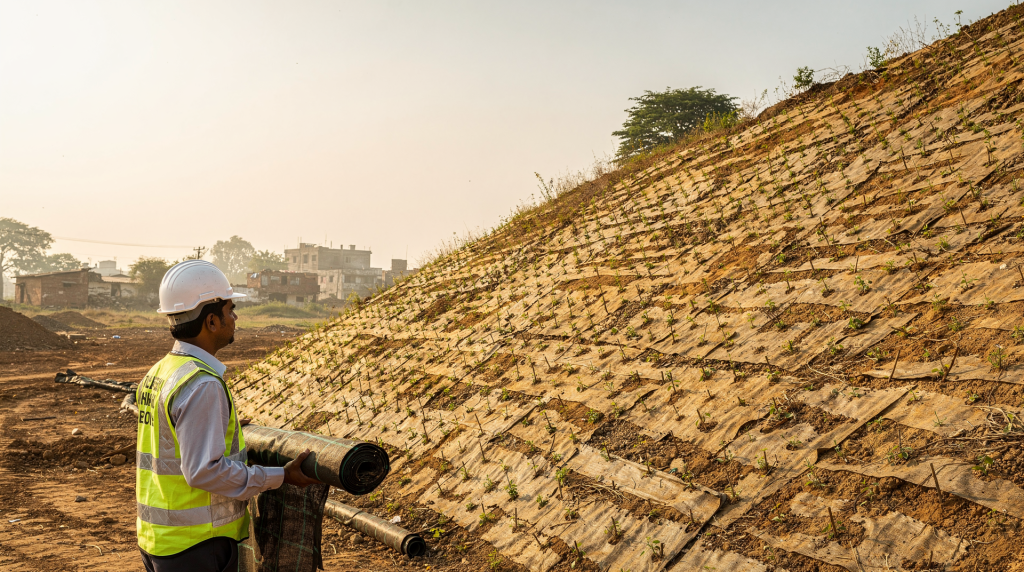
Steep slopes in India fail for a few predictable reasons: runoff cuts grooves into bare soil, water builds up behind weak layers, and loose topsoil slides before vegetation can take hold. Geotextiles help interrupt that process by holding soil in place, slowing runoff, filtering water, and supporting vegetation until the slope becomes stable on its own. Over the years, I’ve seen the same story repeat on sites across the country — a freshly graded slope looks solid through the dry season, then the first monsoon turns it into a mess of rills and slumps. The difference between a slope that holds and one that washes out often comes down to one thing: whether someone took the time to understand how water moves across that piece of land and used the right geotextile to manage it.
Why geotextiles matter on Indian slopes
India’s slope problems are rarely just about “steepness.” In many places, the real issue is a mix of intense monsoon rain, exposed cut slopes, weak fill, and poor surface drainage. I’ve walked onto plenty of residential plots where the builder simply cut into a hillside and left a near-vertical face, expecting a boundary wall to hold it later. What they overlooked was the seasonal trickle of water that migrated through the disturbed soil and slowly turned the whole section into a slumping hazard.
Geotextiles are widely used in civil engineering for separation, reinforcement, filtration, drainage, and protection, including slope stabilization and embankment protection. On practical projects — whether it’s a highway embankment or a private plot — the goal is usually not to make a slope “strong” by fabric alone. The goal is to prevent surface erosion long enough for drainage, vegetation, and soil structure to do their job. I’ve observed on worked slopes that reinforced vegetation combined with geotextiles reduces flow velocity, conserves soil particles, and encourages root growth far better than just throwing seeds onto bare earth.
What geotextiles actually do
A geotextile is a permeable fabric made from synthetic or natural fibers. In slope work, it usually serves one or more of these roles:
- Separation: keeps soil from mixing with aggregate or drainage layers so the drain doesn’t clog and the foundation layer stays intact.
- Filtration: lets water pass while retaining soil particles — critical behind retaining walls and under riprap where fine soil can silently wash out.
- Drainage: helps move water along the surface or through the layer, reducing hydrostatic pressure buildup that often triggers shallow slides.
- Reinforcement: improves the slope’s resistance to shallow movement by adding tensile strength, but it’s not a replacement for proper compaction and grading.
- Protection: shields soil from raindrop impact and surface washout, which matters immensely during the first weeks after cutting a slope when bare soil is most vulnerable.
For slope stabilization in India, the most common win is surface protection. A properly installed geotextile reduces erosion during the first critical months after shaping, when a slope is most vulnerable. I’ve seen a well-anchored coir mat protect a freshly cut slope through an entire monsoon while the neighboring untreated section lost half a metre of topsoil in the same period.
Types of geotextiles used for slope stabilization
| Type | Main use | Best for | Limitations |
|---|---|---|---|
| Woven geotextile | Reinforcement and separation | Steeper slopes, soil retention, subgrade support | Less flexible on rough ground |
| Non-woven geotextile | Filtration and drainage | Drainage layers, protection behind retaining elements | Not ideal as primary reinforcement |
| Jute geotextile | Temporary erosion control | Short- to medium-term slope protection and vegetation establishment | Degrades faster, so not for long-term structural use |
| Coir geotextile | Surface erosion control and moisture retention | Monsoon-prone slopes, revegetation, rural and hill projects | Shorter service life than synthetic options |
In India, jute and coir are especially common for eco-sensitive slopes because they support vegetation and gradually biodegrade without leaving synthetic waste behind. Field studies and Indian practice have shown that open-weave jute geotextiles can reduce runoff and soil loss while improving moisture retention and vegetation growth. I’ve specified coir on several hill plots where the owner wanted natural-looking slope cover, and it performed well when paired with native grasses that took root within six weeks.
When geotextiles are the right solution
Use geotextiles when the slope problem is mainly surface erosion, rilling, shallow sloughing, or loss of topsoil. They are especially useful when:
- the slope has been freshly cut or filled and has no protective cover,
- monsoon runoff is stripping the surface faster than it can recover,
- vegetation has not yet established and the bare soil is exposed to direct rain impact,
- the slope needs temporary protection before planting so seeds don’t wash away,
- the site needs a filter layer behind stone pitching, gabions, or drains to keep fine soil from migrating into open voids.
Use a stronger engineered system when the slope shows signs of deep movement, tension cracks, rotational failure, or persistent seepage. I recall a hill plot where the owner had pinned jute onto a slope that was slowly moving as a whole; within one season the fabric tore at the anchors, and the entire section slid. In those cases, geotextiles alone are not enough — you need retained structures, proper drainage, and sometimes geocell reinforcement.
Choosing the right geotextile for Indian conditions
The right product depends on the slope angle, rainfall intensity, soil type, and whether the job is temporary or long-term. Match the fabric to the failure mechanism you’re seeing, not just the budget or convenience.
1) For temporary erosion control
Choose jute or coir geotextiles when the main aim is to protect topsoil until plants establish. These are common on highway embankments, hill slopes, and landscaped slopes in monsoon regions. I’ve used jute blankets on freshly graded red soil slopes in the Western Ghats; they held the seed bed in place through two heavy spells and had mostly biodegraded by the time the grass canopy closed.
2) For drainage and filtration
Choose non-woven geotextiles where you need water to pass through a layer but want to stop soil migration. This is common behind drains, toe drains, and under riprap or stone protection. I often recommend a non-woven filter behind gabion walls because it prevents the backfill soil from clogging the stone without creating a water barrier.
3) For reinforcement on steeper slopes
Choose woven geotextiles when you need tensile strength and separation, especially in engineered slope systems. They are not a substitute for proper design, but they can improve stability when combined with grading, compaction, and drainage. In my experience, woven fabric works best on cut slopes with a competent base material, where the main risk is shallow surficial sliding rather than deep rotational failure.
Step-by-step: how to use geotextiles on a slope
Step 1: Inspect the slope first
Before buying material, check:
- slope angle — anything over 35–40° usually needs more than a blanket,
- soil type — dispersive clays or loose silty sand behave very differently,
- signs of seepage — damp patches even in dry weather are a red flag,
- rills or gullies that show where water concentrates,
- loose fill or recent cutting that hasn’t settled,
- where rainwater enters and exits — the catchment above the slope often contributes more runoff than the slope itself receives directly.
If water is flowing onto the slope from above, fix that first. A geotextile cannot compensate for bad drainage. I’ve visited sites where the owner had covered a slope with coir but ignored the uphill compound’s terrace discharge, and the concentrated flow simply ripped through the fabric at the inlet point.
Step 2: Shape and compact the slope
Remove loose soil, sharp stones, roots, and debris. Regrade uneven surfaces so the fabric sits snugly — air pockets allow water to channel underneath and start unseen erosion. On fill slopes, compact in layers rather than dumping loose soil in one lift. This is a step that many small projects skip entirely, but it’s what keeps the geotextile from tearing around voids after the first rain.
Step 3: Install drainage controls
A slope should not rely on surface fabric alone. Add:
- top diversion drains to intercept runoff from higher ground,
- lined side drains that carry water safely down without eroding the edges,
- toe drains at the base to collect and redirect water away from the slope’s weakest point,
- temporary channels where runoff is concentrated so it doesn’t cut new gullies.
This is especially important in Indian monsoon conditions, where concentrated flow can tear through even well-covered slopes. I always remind builders: the most expensive geotextile won’t survive if a roadside gutter empties onto the slope without any turnout.
Step 4: Lay the geotextile correctly
Roll the fabric down the slope in the direction that reduces seam stress and water lifting. Overlap adjacent rolls properly, anchor the top edge, and pin the fabric at regular intervals. Practical rules from numerous installations:
- start from the top where possible,
- make sure the fabric lies flat with no air pockets,
- overlap seams generously — at least 300 mm on steep or wet slopes,
- secure edges so runoff cannot get underneath, usually by burying the top and side edges in a small trench,
- avoid stretching the fabric tight over voids; it should drape evenly, not bridge gaps.
Step 5: Add soil, seed, or surface cover
For erosion-control blankets and natural fiber geotextiles, place seed and a thin soil layer as needed. The fabric should protect the seedbed, hold moisture, and reduce the impact of rain splash. This is where coir and jute are especially useful because their open weave allows seedlings to grow through while still breaking the velocity of runoff. I’ve seen coir mats retain enough moisture that germination rates improved noticeably compared to exposed soil, even during a late monsoon break.
Step 6: Inspect after the first rains
The first monsoon events tell you whether the system is working. Check for:
- lifted edges where wind or runoff has started to peel the fabric away,
- washed-out seams,
- blocked drains,
- exposed soil pockets that suggest the fabric shifted,
- rill formation beneath the mat,
- fabric tearing around anchors, often a sign of insufficient pinning or too much tension.
Early intervention can save a slope. Often all it takes is a few extra pins and some soil compaction around the edges; leave it unchecked, and the damage expands quickly.
Common slope stabilization setups
| Situation | Best geotextile approach | Notes |
|---|---|---|
| Newly cut hillside in heavy rain region | Jute or coir blanket with anchoring | Good for early erosion control and vegetation |
| Embankment with runoff at the toe | Non-woven filter + drain layer | Prevents soil migration into drainage zone |
| Steep slope with topsoil loss | Woven reinforcement plus surface protection | Needs proper grading and drainage |
| Landscape slope near a road | Coir mat over seeded surface | Useful where visual appearance matters |
| Behind riprap or stone pitching | Non-woven filter fabric | Stops fines from washing out |
Typical mistakes to avoid
- Using geotextile without fixing drainage — it’s like putting a bandage on a wound that won’t stop bleeding.
- Choosing the wrong product for the job — a non-woven filter alone will not reinforce a steep cut.
- Leaving seams open or poorly overlapped — water finds those gaps and starts eroding from the inside.
- Installing on loose, unprepared soil — the fabric can bridge rills and trap air, leading to uneven settlement and tearing.
- Using natural fiber mats as if they were permanent structural reinforcement — they are sacrificial, not permanent.
- Ignoring toe erosion, which can undercut the whole slope — once the toe goes, the rest follows.
- Skipping inspection after the first monsoon — small failures are easy to fix, large ones require rebuilding the slope.
A common failure pattern in India is this: the slope looks fine in dry weather, but the first heavy rain lifts the edges, water enters underneath, and erosion starts from the bottom or along seams. I’ve stood on sites where a perfectly good coir mat was flapping in the breeze after one storm because the top anchor trench wasn’t deep enough and the side edges weren’t buried.
Jute vs coir vs synthetic geotextiles
| Material | Strength | Lifespan | Best use | Climate fit |
|---|---|---|---|---|
| Jute | Moderate | Short to medium | Temporary erosion control, revegetation | Good for humid, rainy regions |
| Coir | Good surface durability | Medium | Moisture retention and surface protection | Good for monsoon-prone slopes |
| Synthetic geotextile | Higher and more consistent | Long | Reinforcement, filtration, drainage, separation | Good where longer life is needed |
If the project only needs protection until vegetation establishes, natural fiber geotextiles often make sense. If the slope needs long-term filtration or reinforcement — say, behind a retaining wall or where a permanent drain layer is required — synthetic geotextiles are usually the better choice. I’ve seen coir degrade too fast on a perpetually wet north-facing slope where moss grew faster than grass; a non-woven synthetic would have lasted and kept the drainage working.
A simple on-site checklist
- Confirm the slope failure type: surface erosion or deeper instability.
- Identify where water enters, travels, and exits.
- Decide whether the job needs protection, filtration, reinforcement, or all three.
- Prepare and compact the slope surface thoroughly.
- Install diversion drains if runoff is coming from above.
- Select the right geotextile type and thickness based on expected flow and soil conditions.
- Overlap, anchor, and pin properly — edges are the first points of failure.
- Establish vegetation or surface cover quickly so the fabric starts working with roots, not alone.
- Reinspect after the first major rain and correct any immediate issues.
When to call in an engineer
Seek professional design if the slope has:
- visible cracks, especially at the top or mid-slope,
- signs of landslip — tilted trees, displaced fence posts,
- saturated soil even days after rain,
- persistent seepage spots that don’t dry out,
- a very steep cut or fill where small failures could cascade,
- a history of failure — old scarps or slide debris at the toe,
- infrastructure at risk below the slope — a house, road, or neighbour’s property.
In those cases, geotextiles may still be part of the solution, but they should sit inside a broader stabilization plan that may include grading, retaining structures, drainage, geocells, gabions, or reinforced soil systems. I always tell plot owners: if you see cracks that widen after a storm, don’t just cover them with a mat — get a geotechnical opinion first.
Final takeaways
Geotextiles work best on Indian slopes when they are treated as part of a system, not as a standalone fix. The real sequence is simple: control water, prepare the slope, choose the right fabric, anchor it correctly, and establish vegetation or permanent cover before the monsoon does the testing for you. After years of watching both successes and washouts, I can guarantee that spending a weekend on drainage and a properly pinned geotextile will save you far more than the cost of cleanup and regrading later.
FAQ
Can geotextiles stop a landslide?
No. They help control erosion and shallow surface movement, but they do not fix major slope instability. If the slope is moving deeper than a few inches, the root cause is almost always groundwater or a weak soil mass, and that requires engineered stabilization.
Which geotextile is best for erosion control in India?
For temporary erosion control and vegetation support, jute or coir is often the most practical choice. For filtration and reinforcement, synthetic geotextiles are usually better. The decision really hinges on how long you need the fabric to function and whether you want it to disappear once vegetation takes over.
Do geotextiles work in heavy monsoon areas?
Yes, if drainage is designed properly and the fabric is installed and anchored correctly. A well-drained slope with a geotextile performs far better than a bare slope in intense rain, but it demands that water is led away, not allowed to pond behind the fabric.
How long do natural fiber geotextiles last?
They are designed to be temporary. Their useful life depends on fiber type, thickness, moisture, and site conditions. In warm, wet, biologically active soils, jute may degrade within a few months; coir can last a season or two, but neither is a permanent solution.
Do I need vegetation after installing geotextile?
Usually yes. Vegetation is what gives the slope longer-term protection after the fabric has done its job. I’ve seen slopes where the geotextile degraded and left bare patches that began eroding immediately because no grass was established. The fabric buys you time; plants secure the permanent cover.