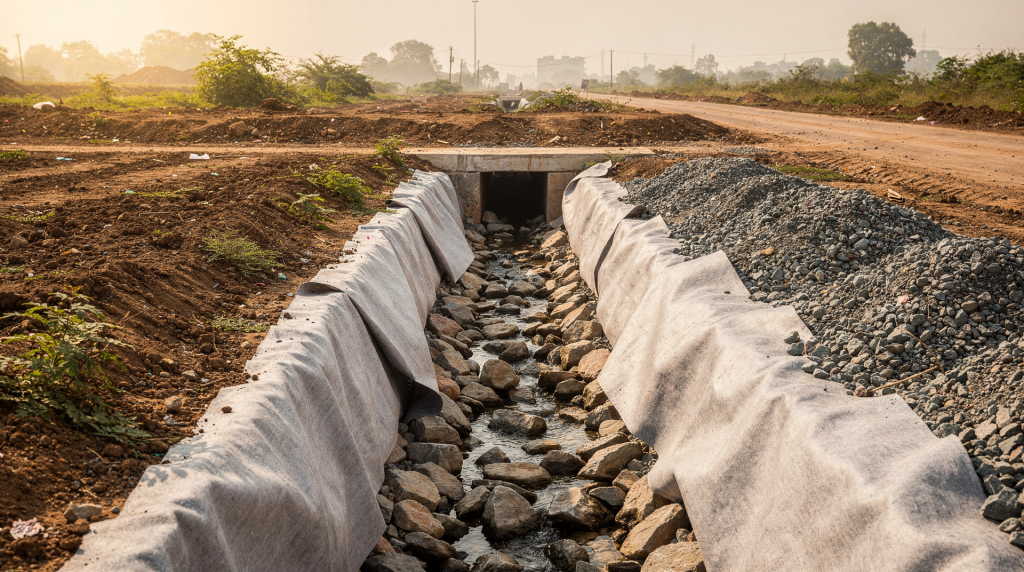
When drainage channels fail, the problem is rarely the water itself. Almost every time I’ve traced a clogged trench or a silted-up outlet back to the root cause, it’s been the soil moving with the flow. Geotextiles solve that by letting water through while holding fines in place, keeping gravel clean, and making sure the drain keeps working season after season.
On residential sites — especially where monsoon rains hit newly cut slopes, compacted fill, or narrow side yards — this is not a “nice to have” detail. It’s the difference between a dry foundation and a waterlogged setback that needs to be dug out and redone after one heavy storm. Used correctly, geotextiles keep shallow drains, curtain drains, and foundation drains open and stable instead of turning into long, expensive silt traps.
What a geotextile does in a drainage channel
A drainage channel has one straightforward job: move water away without letting the surrounding ground migrate into the drain system. In practice, that means water has to leave, but the soil has to stay behind. Geotextiles support that job in three ways, and all three matter on a typical building plot.
- Filtration: water passes through the fabric, but soil particles are retained. It’s the same principle as a coffee filter — liquid moves, solids stop — except here the filter has to handle silt, clay, and sand under variable flow, not just ground coffee.
- Separation: two different materials, like native silty soil and clean drainage gravel, are kept from mixing. Without a separator, gravel gets choked with fine soil in weeks, and the drain loses its open pore space.
- Flow control: the fabric helps direct water into the drainage layer or perforated pipe while maintaining a stable interface. It doesn’t throttle the water; it gives the water a predictable path along the drain without letting the surrounding soil collapse inward.
Think of the geotextile as a tough, permeable skin around the drain: it breathes water, holds back soil, and protects the drainage media from contamination.
Why filtration is the core function
In both surface and sub-surface drainage, the primary job of a geotextile is filtration — allowing water to enter the drainage zone while preventing fine particles from washing into the pipe or aggregate. Get this balance wrong and one of two things happens: either the fabric blocks too much water and hydrostatic pressure builds up behind it, or it lets too much soil through and the drain silts up from the inside, losing capacity bit by bit.
Striking the right balance depends on three factors you can’t ignore on site:
- Soil gradation: the size distribution of soil particles. If a soil has a wide range of particle sizes, the tiny ones can wash out while the bigger ones form a stable filter bridge — or everything can pass through if the fabric openings are too large.
- Plasticity: clayey soils can smear under wet conditions and literally plug the fabric pores with a thin, impermeable skin. I’ve pulled out geotextile from a failed drain and found it covered in a slick clay paste that blocked nearly all flow.
- Hydraulic conditions: how fast water is expected to move through the system. High-velocity runoff, common on slopes during a monsoon downpour, hits the fabric with more energy and can force fines through a fabric that works fine under slower seepage.
This is why there is no one “best” geotextile for every drain. A sandy roadside swale, a gravel-packed retaining wall drain, and a toe drain at the base of a slope all need different filtration behaviour.
Filtration vs separation: not the same job
These two functions are often mixed up, but they solve different problems on site, and specifying the wrong one leads to early failure. Filtration deals with water and soil particles moving together; separation deals with two different solid layers that shouldn’t intermix.
| Function | What it prevents | What it allows | Typical use |
|---|---|---|---|
| Filtration | Soil particles entering the drain | Water passing through | Wrapped drains, trench drains, wall drains |
| Separation | Mixing of two dissimilar layers | Load transfer between layers | Soil over gravel, subgrade under aggregate |
A French drain beside a foundation is the classic example where both functions are needed at once. The clean gravel inside the trench must stay open and free-draining. The geotextile wrap keeps the surrounding native soil from migrating into the stone while simultaneously letting groundwater seep into the drain. Miss either function and you’ll be digging it up within a couple of monsoons.
Where geotextiles are used in drainage channels
Geotextiles aren’t limited to big infrastructure projects. On a residential plot, they find their way into a surprising number of drainage details:
- Trench drains and interceptor drains that cut off shallow groundwater or surface runoff
- Blanket drains under landscaped areas or behind retaining walls
- Pavement edge drains along driveways and pathways
- Wall and structure drains that relieve hydrostatic pressure behind basement walls or compound walls
- Drainage channels and water evacuation paths across slopes or property boundaries
- Drains beneath permeable bases, gravel driveways, or granular sub-base layers
In Indian site conditions — particularly on the fringes of cities where plots are cut into hillsides or filled over old low-lying ground — these applications become critical in the monsoon. Runoff carries fines from unpaved access roads, compound edges, freshly graded ground, and temporary soil stockpiles. Even a short, shallow channel can clog completely if it isn’t lined with the right fabric.
Choosing the right geotextile: practical selection rules
The right fabric depends on what your soil does when it gets wet, how much water you’re dealing with, and how the drain will be installed. There is no universal catalog answer, but a simple field-level selection framework gets you close:
| Site condition | What you need from the geotextile | Practical preference |
|---|---|---|
| Sandy soil with moderate flow | High permeability with good retention | Non-woven fabric with appropriate opening size |
| Silty soil | Strong clogging resistance | Fabric with a pore structure that stays open under fines loading |
| Clayey soil | Good filtration plus careful detailing | Conservative design; don’t rely on fabric alone — clay can smear and clog |
| Gravel drain around pipe | Separation and filtration | Non-woven wrap around aggregate |
| Repeated heavy rain / monsoon runoff | Durable flow control and survivability | Fabric that can handle placement, compaction, and long-term exposure to high flows |
Field experience shows that a fabric that is too “tight” clogs quickly, especially in silty or clayey ground. A fabric that is too open loses soil and the drain fills with sediment. The best choice is always a carefully judged balance between retention and permeability, and that balance shifts with every site.
Common geotextile types used in drainage
Two categories of geotextile dominate drainage work, and they behave very differently in the ground.
- Non-woven geotextiles: These are the default for most drainage applications. They offer excellent water passage, are forgiving when wrapped around irregular trench profiles, and perform dual duty as a filter and separator. Their fibrous structure gives them good puncture resistance when placed over compacted subgrade.
- Woven geotextiles: These are used where higher tensile strength or pure separation is required, for example under heavy aggregate loads or where the fabric must bridge soft spots. However, they are often less effective in filtration-heavy drainage because their pore structure is less three-dimensional, which can lead to quicker blinding by fine particles.
For most residential drainage channels — foundation drains, slope interceptors, gravel-filled trenches — a non-woven geotextile is the practical first choice. It combines filtration and separation in one product, and handles the typical soil and water conditions found on building plots.
How to install geotextiles in a drainage channel
Even the best geotextile won’t save a drain if it’s torn, poorly overlapped, or left exposed. Proper installation is simple but unforgiving of shortcuts.
- Prepare the channel base: Remove sharp stones, construction debris, roots, and anything that can puncture the fabric. A flat, clean subgrade is not optional.
- Shape the channel correctly: The drain must already have the right longitudinal slope and a clear outlet path before the geotextile goes in. The fabric follows the shape; it doesn’t create it.
- Lay the geotextile without tension: Allow enough slack so the fabric can conform to the trench without stretching, and leave generous overlap at the edges to wrap fully around the drainage aggregate. Overlaps of at least 300 mm along the length are a safe field minimum.
- Place drainage aggregate carefully: Don’t dump stone from height directly onto the fabric. Place it gently to avoid impact tears. Where practical, place a thin cushion layer of finer aggregate first.
- Compact in layers if required: Field guidance from Indian railway drainage work indicates that geotextiles should be covered with a minimum 300 mm of loosely placed aggregate before any mechanical compaction begins. That layer shields the fabric and prevents direct damage from vibratory plates or rollers.
- Protect the fabric from exposure: Geotextile shouldn’t sit in the sun or open air longer than necessary. UV degradation can weaken it, especially during construction delays. Cover it as soon as the aggregate layer is in place.
- Connect to a proper outlet: The best geotextile in the world can’t compensate for a drain that has nowhere to discharge. Ensure the outlet is clear, protected from backwater, and sized for peak flow.
Design mistakes that cause drainage failure
After years of troubleshooting failed drains on residential and infrastructure projects, I’ve seen the same handful of mistakes repeat. Most are preventable with a bit of pre-installation thought.
- Using the wrong fabric opening size for the soil — either too tight and water pressure builds up, or too open and sand or silt washes into the void space.
- Installing fabric over muddy, damaged, or unconsolidated subgrade — the fabric contours poorly and can’t bond with the underlying soil.
- Leaving gaps in overlaps — even a small separation allows soil to pipe through and undermine the drain from the inside.
- Placing aggregate too aggressively — dropping stone from a height tears the fabric and creates weak points that grow into full-blown failures.
- Using geotextile as a substitute for slope correction — if the drainage path is flat and water ponds, fabric doesn’t create gradient; it only filters.
- Building a drain without a proper outlet — water backs up, sediment drops out, and the channel becomes a linear swamp.
- Assuming geotextile can fix a badly graded site — it’s a control layer, not a redesign of the topography.
The single biggest misconception I encounter is treating geotextile as a cure for poor drainage design. It is a control layer, not a replacement for proper grading, slope planning, or discharge design. Get the fundamentals right first, then add fabric to make them last.
Flow control: what it really means on site
“Flow control” in drainage channels doesn’t mean throttling water like a valve. It means keeping water moving along the intended path while stopping the soil from collapsing into that path and blocking it. Geotextiles achieve this by:
- Maintaining a stable, rigid interface between the native soil and the drain media — the soil can’t slump into the drain voids.
- Preventing fine particles from clogging gravel and perforated pipes, so the capacity stays constant even after repeated storms.
- Supporting lateral movement of water toward collection points, especially in narrow drainage strips where wide rubble fills aren’t practical.
This is especially valuable where water must travel under paths, beside retaining structures, or through narrow building setbacks. In those confined spaces, a well-wrapped geotextile channel ensures that the limited void space doesn’t get choked with trash soil. It’s a cheap way to make a small footprint drain work reliably.
Quick checklist before specifying a geotextile
- Identify the soil type on site: sand, silt, clay, or mixed fill — don’t guess, dig a small trial pit.
- Confirm the drain type: trench drain, surface channel, wall weep system, or blanket drain — each needs a different detailing approach.
- Estimate water volume and storm intensity — think in terms of monsoon peak, not average rainfall.
- Check whether the main risk is clogging (fines choking pores), soil loss (piping), or both.
- Decide whether filtration or separation is the primary function; if both are needed, select accordingly.
- Verify outlet discharge — walk the path and make sure water can actually leave the drain without obstruction.
- Confirm installation method and protection during compaction — if the contractor intends to compact over the fabric, specify the aggregate cushion thickness clearly.
When geotextile is not enough
A geotextile dramatically improves drainage performance, but it has limits. It cannot compensate for fundamental site problems that need structural or grading solutions first.
- Flat grading with no fall — water won’t move, fabric or not.
- Blocked outlets — if the exit is submerged or choked, the drain stops working from the downstream end.
- Highly compressible soil with no subgrade preparation — fabric over soft, settling ground will stretch and possibly tear as the soil deforms.
- Major seepage coming from uphill without interception drains — a single channel line can’t handle water that’s still moving through the slope above it.
- Structural drainage that needs a full engineered system — walls, deep basements, and landslide-prone slopes demand more than a wrapped trench.
If the site has chronic waterlogging, visible slope movement, or weak foundation soil, the drain design itself must be upgraded — not just wrapped in fabric. Adding geotextile to a fundamentally undersized or misgraded drain is like putting a good filter on a broken pump.
Practical takeaway for Indian plots and site prep
On Indian residential sites — especially those on cut-and-fill terraces, hill slopes, or plots bordered by unpaved roads — geotextiles are most useful where monsoon runoff meets loose soil, freshly cut slopes, or gravel drains around foundations. Used correctly, they keep drainage channels open, stop fines from migrating into expensive gravel packing, and reduce the likelihood of expensive rework after the first heavy spell.
The rule I’ve followed on hundreds of sites is simple: correct grading first, plan the drainage layout and outlet second, and specify the geotextile third. That sequence gives the fabric a job it can actually do, and your drain will still be functioning when the next monsoon arrives.
FAQ
What is the main function of geotextile in drainage channels?
Its main function is filtration — allowing water to pass while retaining soil particles. When that works, everything else follows.
Can geotextile replace gravel in a drain?
No. Geotextile is a filter and separator, not a structural medium. It supports the drain system but does not provide the void space or load-bearing capacity that gravel does. Without proper aggregate volume, the water has nowhere to flow.
Is non-woven geotextile better for drainage?
For most drainage applications, non-woven geotextiles are preferred because they offer good filtration, handle wrapping around irregular shapes, and are less prone to rapid clogging compared to many woven types in fine soil conditions.
Why do geotextile drains clog?
Clogging usually happens when the fabric’s pore size is poorly matched to the soil, when installation damage tears or smears the fabric, or when the overall system lacks proper gradient and outlet capacity. In many cases, the clog is not in the fabric itself but in the gravel or pipe that has been contaminated by bypass soil.
Can geotextile stop erosion in a channel?
It can help control erosion by keeping soil in place at the drain interface and preventing fines from washing away. However, it must be paired with proper channel geometry, slope stabilisation, and outlet protection. Fabric alone won’t hold the banks in place if the flow is concentrated and fast.