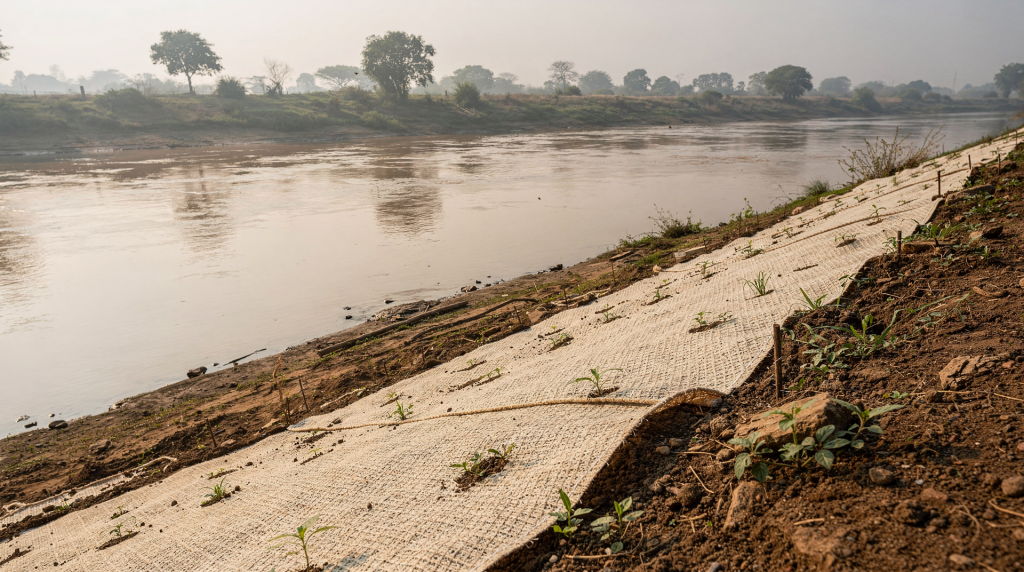
Geotextiles are permeable fabrics that handle several critical jobs in the ground: they separate, filter, drain, protect, and reinforce soil layers. For erosion control, their main role is keeping soil in place while letting water pass through — a combination you need almost everywhere on a site once the monsoon hits or a slope is left open. I’ve seen them work on highways, in mine reclamation, and now regularly on residential plots, where one unprotected rainstorm can undo weeks of earthwork. For a homeowner or a builder, the practical benefit is straightforward: geotextiles drastically reduce washout, stop fine soil from mixing into stone or gravel backfill, and buy valuable time until permanent solutions like vegetation or hard armour take hold.
What a geotextile actually does
When I walk a site with a private developer, I describe geotextile as a technical “skin” placed between soil and whatever sits above it — gravel, riprap, a drainage layer. It’s never just a dumb sheet of cloth; its thickness, pore size, tensile strength, and the way it’s laid all determine which job it performs. This is the first thing to get right, because choosing the wrong type of fabric for the job is one of the most expensive mistakes you can make.
Main functions of geotextiles
- Separation: prevents soft, fine subgrade soil from pumping up into the stone or aggregate layer above. On a gravel driveway carved into clayey hill soil, I’ve seen the stone disappear into the mud within one season when separation was skipped. A woven geotextile stops that mixing completely.
- Filtration: allows water to move through the fabric while holding back soil particles. This is the mechanism that keeps the ground from being sucked out from under riprap — the water drains, the fines stay.
- Drainage: helps water move along the plane of the fabric or through its thickness without clogging. In a retaining wall backfill or a slope drain, a nonwoven geotextile often doubles as a drainage path if the site grading doesn’t provide a faster outlet.
- Protection: shields the underlying soil from direct raindrop impact and the shear stress of flowing water. On a bare cut slope, the difference between a protected surface and one exposed to a heavy downpour can be measured in cubic metres of lost soil after a single night.
- Reinforcement: in certain configurations, geotextiles can add tensile strength to weak or sloping ground, though this is a narrower application. I’ve used woven fabrics beneath fill lifts on marginal soils to spread load and keep the platform stable during construction.
The same roll of fabric can act as a filter under stone, a separator on a subgrade, and a temporary cover on a slope — it all depends on how it is designed into the sequence of layers.
Why geotextiles matter in erosion control
Erosion starts the moment bare soil is hit by raindrops, sheet runoff, or a concentrated flow. The top layer loosens, fines go into suspension, and water quickly cuts rills that grow into gullies. Once that cycle begins, the damage compounds with every storm. What geotextiles do is interrupt that cycle at the surface. They protect the soil from direct impact, slow down the flow velocity, and stabilise the system long enough for vegetation or hard armour to take over the job permanently.
In Indian conditions — intense monsoon bursts, freshly cut slopes along access roads, poorly graded fill, and plots that sit right in the path of hillside runoff — this becomes urgent very quickly. On one hillside job near Lonavala, a contractor left a cut face exposed for ten days in June. Without any protection, the slope lost over 30 cm of weathered rock and soil before a geotextile and riprap cover could be installed. The repair cost was three times the original cover budget. That memory sticks with me every time I see a site left open before the monsoon. If the surface is unprotected, one bad season can undo months of earthwork. A properly selected geotextile is often the cheapest insurance against that kind of risk.
Common types used in erosion control
Over the years I’ve relied on three main categories of geotextile for erosion work, and the choice always starts with the type of stress the fabric will see and how much water has to pass through it.
| Type | Main strength | Typical use |
|---|---|---|
| Woven geotextile | Higher tensile strength, better for separation and reinforcement | Roads, subgrades, under aggregate, some slope applications |
| Nonwoven geotextile | Better filtration and drainage, thicker and more flexible | Drainage layers, filters, protection under riprap |
| Natural geotextile (coir, jute) | Biodegradable, supports temporary erosion protection | Slope revegetation, temporary soil cover, rural and ecological projects |
A woven geotextile gives you high strength and controlled pore sizes, but it’s not as good at filtration as a nonwoven. Nonwovens are fluffier, handle fine particles better, and can drain water in-plane, but they don’t provide the same separation strength under heavy load. Natural fabrics like coir matting are ideal when the long-term plan is vegetation: they hold moisture and protect seedlings, then degrade as the roots take over the stabilisation. I’ve also used them on remote hill sites where bringing synthetic material was simply not practical.
Where geotextiles are used in erosion control
1. Under riprap and stone pitching
This is one of the most common applications I specify on residential slopes and channel banks. When stone is placed directly on soil, water flowing through the voids between rocks carries out fine particles. The result is a hidden cavity under the armour that grows with each rain. A nonwoven geotextile laid between the prepared soil and the riprap acts as a filter: water passes through, but the soil stays put. Without that layer, I’ve seen stone pitching settle into craters after a single heavy monsoon. On a stream bank near Pune, we retrofitted a failed riprap with a proper filter fabric, and the same stone has held stable for four seasons now.
2. In drainage channels and ditches
Roadside drains, diversion ditches, and stormwater channels often carry high-velocity flows that are too strong for bare earth but don’t necessarily require a full concrete lining. Here, geotextile is used to protect the erodible bed and banks. I typically line the channel profile with a suitable nonwoven fabric, anchor the edges, and place stone or rubble over it. The fabric prevents scouring of the soil beneath and allows excess pore water to drain, reducing the risk of back-erosion where water tries to bypass the stone. This detail has saved countless culvert inlets from being undercut on projects I’ve supervised.
3. On steep slopes
Exposed slopes shed rain at speed. A geotextile held in place with anchors or pins reduces rain splash, cuts down surface flow velocity, and buys time for grass or shrubs to establish. I always combine it with hydroseeding or erosion-control blankets on slopes steeper than 1V:2H. A biodegradable natural fabric can be an excellent choice here: it degrades slowly, stabilises the topsoil, and the vegetation eventually takes over. I’ve also used synthetic fabrics under a light cover of topsoil to hold steep road cuts while the roots developed. The key is making sure the edges are properly secured and that water doesn’t get underneath the fabric from the top of the slope.
4. As silt fences and inlet protection
Installed vertically along the site perimeter, a strip of geotextile functions as a sediment barrier. It slows down sheet flow and traps suspended soil before it leaves the construction area. I recommend this as a standard measure on any site where excavation exposes soil near a storm drain or a neighbouring plot. The fabric needs to be trenched into the ground at the base and supported by stakes strong enough to handle the hydraulic pressure of ponded water. Silt fences aren’t a substitute for proper drainage, but they are an excellent final trap that stops fines from clogging downstream drains.
5. For temporary cover on exposed soil
If earthwork stops for a few days and rain is forecast, I always ask the crew to roll out a geotextile over the exposed surface and weigh it down with sandbags or rocks along the edges. It sounds simple, but this quick measure prevents rill erosion that can cut right into a compacted fill. I’ve walked onto sites after an unplanned downpour to find the only intact areas were those that had a temporary cover. A roll of old nonwoven fabric stored on site is worth its weight in diesel when the monsoon catches you by surprise.
Geotextiles vs erosion-control blankets: not the same thing
This confusion comes up on almost every residential site I visit. Geotextile is the broader category of permeable synthetic or natural fabric used in civil works. An erosion-control blanket is a specific product designed to be placed on the surface, usually made of straw, coir, or synthetic fibres stitched into a degradable net, and its main purpose is to foster vegetation while protecting against raindrop impact. A turf reinforcement mat is a heavier, permanent version meant to reinforce the vegetation mat under high-velocity flow. So while all erosion-control blankets are geotextiles in the broadest sense, not every geotextile is meant to be a surface blanket. Using a thick nonwoven filter fabric on a slope expecting it to act like a vegetated blanket will usually disappoint you: it won’t let seedlings through, and it can trap heat and moisture in a way that damages young plants. Match the product to the function, not to the price tag.
How to choose the right geotextile
I start every selection with three questions: what is the soil type, how does water move across the surface, and how steep is the ground? The table below summarises what I’ve found to be the safest pairing across most Indian site conditions.
| Site condition | Better choice | Why |
|---|---|---|
| Under stone or riprap | Nonwoven filter fabric | Lets water pass and prevents soil loss |
| Separation under gravel or fill | Woven geotextile | Reduces mixing of layers and improves stability |
| Drainage channel with flowing water | Filter + protection fabric | Resists clogging and protects soil from scouring |
| Temporary slope cover | Erosion-control blanket or natural geotextile | Supports vegetation and reduces rain impact |
| Sediment control at site edge | Silt fence fabric | Traps suspended soil in runoff |
What to check before buying
- Soil type: Fine clay and silt need a fabric with smaller opening sizes (usually a nonwoven) to actually retain particles. A woven with large pores will let the fines pass straight through, and you will have pumped soil in your stone layer within weeks.
- Flow condition: Sheet flow over a gentle grade requires a different filtration capacity than concentrated channel flow. If water is moving fast, the fabric must resist higher local shear stresses and still let the water exit without building up pressure underneath.
- Slope steepness: On a 1:1 cut, surface runoff can generate enough force to pull a poorly anchored fabric up. The steeper the slope, the more critical mechanical anchoring becomes — pin spacing, edge burial, and overlap length all need to be checked.
- Exposure time: A natural coir blanket will degrade within a season or two, which is fine if you want it to disappear as vegetation establishes. A synthetic fabric left exposed to UV for months will become brittle and tear. If the cover is temporary, plan for removal or ensure the fabric is UV-stabilised.
- UV exposure: Even UV-treated polypropylene will degrade over time if fully exposed. I’ve seen temporary silt fences turn into brittle lace after one summer because they were not stored or shaded. Cover with soil, stone, or vegetation as quickly as possible.
- Drainage requirement: The fabric must be able to pass the expected water volume without building up head. A clogged fabric acts like a dam, and the resulting pore pressure can lift the entire protection layer. When I’m unsure about clogging potential in silty soils, I test a small section before committing to a full install.
Installation mistakes that cause failure
The best geotextile on the market will fail if it’s laid poorly. I’ve collected a long list of failures over the years, and almost all of them come back to a handful of recurring errors.
Common mistakes
- Using the wrong fabric type: substituting a woven for a nonwoven under riprap because it was available on site is a classic. The woven will filter poorly and often tears under the weight of stone placement.
- Leaving overlaps too small: on slopes and channels, tension from runoff can pull a 10 cm overlap apart. I recommend a minimum 30 cm overlap for most field conditions, and more on steep ground.
- Not anchoring edges properly: fabric that terminates at the surface without being keyed into a trench or pinned down will be lifted by wind and water. I’ve seen entire slope covers peel off because the top edge wasn’t buried.
- Placing fabric on loose, uneven, or muddy ground: the subgrade must be smooth and firm. Lumps and depressions create stress points that tear the fabric when load is applied. On one site, a large clod of rock punctured the fabric as soon as the first dump truck ran over it.
- Allowing stone to puncture or shift the fabric during placement: dropping stone from a bucket straight onto the fabric often rips it. I insist that the first layer of stone be placed carefully, with minimal drop height, or a cushion layer of sand be used on top of the fabric.
- Using a fabric that clogs too easily in fine soils: a geotextile with too tight a pore structure or insufficient permeability can blind off quickly. Water builds up behind it, and the whole system fails. A local soil test followed by a permeability check can prevent this.
- Leaving exposed fabric open to sunlight and weather for too long: I require that any exposed synthetic geotextile be covered within a few weeks at most. If that’s not possible, I switch to a UV-stabilised product or a natural fibre that’s meant to degrade.
A persistent error on small residential jobs is the “universal fix” mindset. A geotextile is not a replacement for good drainage. If the slope is too steep, runoff path uncontrolled, or groundwater isn’t intercepted, the fabric only buys a little time before the failure appears somewhere else.
Practical example: how geotextiles help on a residential plot
When my extended family bought a gently sloping plot outside Pune, the first monsoon revealed a concentrated runoff stream crossing the high side cut and scouring a gully through the future foundation zone. The approach we took illustrates the sequence that makes geotextile work efficiently:
- Regrade the surface to divert sheet flow away from the building envelope. We reshaped a shallow swale at the top of the slope so water was intercepted before it gained speed.
- Add shallow diversion drains along the cut edge. These were simple, hand-dug channels lined with nonwoven fabric and small stone. The fabric stopped the channel from self-scouring and allowed water to exit freely.
- Line the main drain with geotextile and rock where flow concentrated. The fabric acted as both filter and bed protection, keeping the stone from sinking into soft soil during the peak monsoon.
- Use fabric under riprap at the vulnerable toe of the cut slope. Without that layer, I knew the water would undercut the rock and eat into the slope face from the bottom up.
- Protect exposed soil with a jute mesh blanket and seed mix. The blanket held moisture and shielded the slope while the grass established. Within four months, the roots had taken over the stabilisation job.
- Install a silt fence along the downstream boundary to catch any sediment that escaped during construction. This kept the neighbour’s land and the roadside drain clean.
The sequence matters: geotextile isn’t a standalone hero. It works inside a drainage plan, where each component reinforces the others. On that plot, we didn’t have a single erosion event after the system was installed, and the foundation pad stayed dry and stable through the following monsoon.
Step-by-step checklist for using geotextiles on site
Before installation
- Identify where water enters, flows across, and exits the site. Map the catchment and the concentrated flow paths.
- Mark erosion-prone zones: slope toes, channel bends, outlet points, exposed fill faces, and any area where runoff crosses a cut edge.
- Confirm the soil type and whether fines are likely to wash out. A simple jar test can tell you the silt and clay content.
- Choose the correct fabric type for each zone: filtration, separation, or surface protection. Don’t assume one fabric works everywhere.
During installation
- Clear all sharp stones, roots, and debris from the base. The surface must be smooth and free of anything that can puncture the fabric.
- Place the fabric flat, without wrinkles or slack that can create folds and stress points.
- Overlap joints properly. I use a minimum 30 cm side and end overlap, and more where water flow is across the joint.
- Anchor edges securely: bury the top edge in a small trench, pin the side edges, and key the toe of slope covers so runoff cannot lift the material.
- Place rock or cover material carefully. I prefer to hand-place or use a rock bucket positioned close to the surface; dropping from height guarantees tears.
After installation
- Inspect within 24 hours after the first heavy rain. Look for undercutting at edges, tears, fabric uplift, or signs of soil pooling behind the fabric.
- Check for clogged areas: if water is ponding on top of the fabric and not draining through, you may need to swap to a more open filter medium.
- Repair damaged sections immediately. Small tears grow fast once water gets behind them.
- Keep runoff paths clear of debris and blocked outlets. A single blocked culvert can redirect flow onto a protected slope and overwhelm the system.
When geotextiles are the right answer, and when they are not
A geotextile is a strong, often indispensable component when the main challenge is surface erosion, soil separation under load, filtration, or temporary stabilisation. I’ve built hundreds of metres of erosion protection around those functions with good results.
However, geotextile alone is not enough when the site’s deeper problems are structural. If the slope geometry is inherently unstable, the groundwater table is driving failure, or the soil itself is too weak to support the intended cut, simply covering the surface will not make the ground safe. In such cases, I’ve had to combine geotextile with regrading, retaining walls, subsurface drains, or geogrid/geocell reinforcement. One hillside plot needed a row of soil nails and a drainage gallery behind a facing, with a filter fabric only as the interface material. The fabric played a valuable role, but it was the overall engineering that kept the house from moving downhill. The rule is simple: what you can’t fix with a sheet of fabric, you must fix with grading, drainage, and structure.
Key takeaways
- Geotextiles are permeable fabrics that separate, filter, drain, protect, and reinforce soil layers. Their value in erosion control comes from letting water pass while holding soil in place.
- They work under riprap, in drains, on slopes, and as temporary sediment-control barriers. Each application demands a specific type of fabric chosen for its pore size, strength, and filtration capacity.
- Correct selection and careful installation matter more than the material brand. Overlaps, anchoring, and base preparation are where most field failures begin.
- On Indian sites, especially before and during the monsoon, geotextiles perform best when they are part of a proper grading and drainage plan — not as a standalone patch.
FAQ
What is the main purpose of geotextile in erosion control?
Its main purpose is to keep soil in place while allowing water to pass through. This reduces washout, scouring, and soil loss from slopes, channels, and exposed construction areas.
Is geotextile waterproof?
No. Geotextiles are deliberately permeable. Their job is to let water flow through while filtering out soil particles.
Can geotextile be used on slopes?
Yes. It is commonly used on slopes to reduce rain splash, support vegetation establishment, and protect the soil surface until the slope becomes naturally stable.
What is the difference between geotextile and silt fence?
A silt fence is one specific application of geotextile. The fabric is installed vertically to trap sediment-laden runoff, whereas geotextile as a category covers a much wider range of fabrics and functions.
Do all drainage channels need geotextile?
Not always, but many erodible channels benefit from it. Where water velocity is high or the soil is fine and easily washed away, a geotextile lining can prevent scouring and keep the channel profile intact.
Can natural materials like coir or jute be used?
Yes. Natural geotextiles like coir and jute are used in erosion-control and revegetation projects, especially where temporary protection and plant establishment are the primary goals. They break down over time, leaving stabilised soil behind.